
Byju's fall from India's most valuable startup to insolvency was written in its filings.
Photo · Illustration: Business Index
Inside the Byju's postmortem: what the numbers always said
From a $22 billion valuation to insolvency, Byju's collapse is now fully documented in belated filings and NCLT records. The warning was always in the numbers.
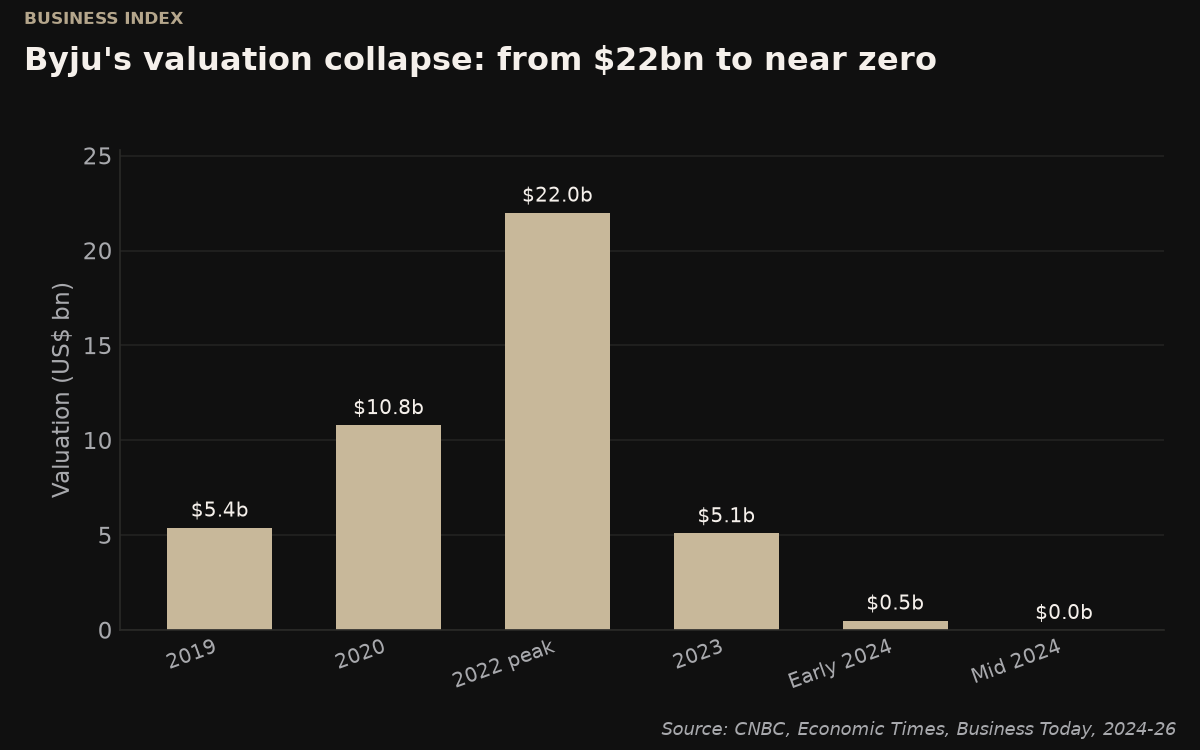
At its peak in 2022, Byju's was valued at $22 billion — India's most valuable startup, a national champion of edtech (Source: CNBC, March 2024). Within two years it was in insolvency. The collapse is now exhaustively documented in belated financial filings and NCLT records, and the uncomfortable conclusion of the postmortem is that the warning signs were in the numbers all along — they just arrived late.
The numbers that came late
The first red flag was the accounts themselves. Byju's FY21 results were filed about 16 months late and, when restated, showed revenue of Rs 2,280 crore against a loss of Rs 4,588 crore — losses more than double revenue (Source: Economic Times, September 2022). FY22 was worse in absolute terms: Rs 5,014 crore revenue, Rs 8,245 crore consolidated loss (Source: Economic Times, January 2024). A company burning roughly Rs 1.60 for every rupee of revenue, while delaying its filings by more than a year, was signalling distress in the only language that matters.
Losses double the revenue, filed 16 months late. The postmortem was legible before the patient died.
The debt trap
On top of the operating burn sat a roughly $1.2 billion Term Loan B from US lenders, which became the centre of a bruising legal dispute over alleged fund diversion (Source: multiple reports, 2023–24). Byju's had raised about $5.8 billion across its life from marquee investors, yet the debt layer — not the equity — is what tightened the noose, because lenders have covenants and courts.
The trigger
The final collapse came from an almost trivial-looking figure: Rs 158 crore in unpaid dues to the BCCI, which triggered the NCLT insolvency petition admitted in 2024 (Source: NCLT order, 2024). A company once worth $22 billion was tipped into insolvency over a sum a fraction of a percent of its former valuation — the classic signature of a business with no liquidity behind a huge paper value.
The breakdown
By early 2024 a rights issue was being explored at around a $500 million valuation, a fall of more than 97% from the peak, before the value effectively went to zero at insolvency (Source: Economic Times, January 2024; Business Today, 2026). The postmortem's lesson is not that Byju's failed suddenly. It is that valuation and viability had decoupled years earlier — the losses, the late filings, the debt covenants and the liquidity gap all said so. The market chose to read the $22 billion headline instead of the filings underneath it. The numbers always said the rest.
Sources
One email. Saturday morning.
The week that mattered.
The five stories you needed to read, the data point of the week, and what to watch. From the Business Index editors. No ads, no fluff.