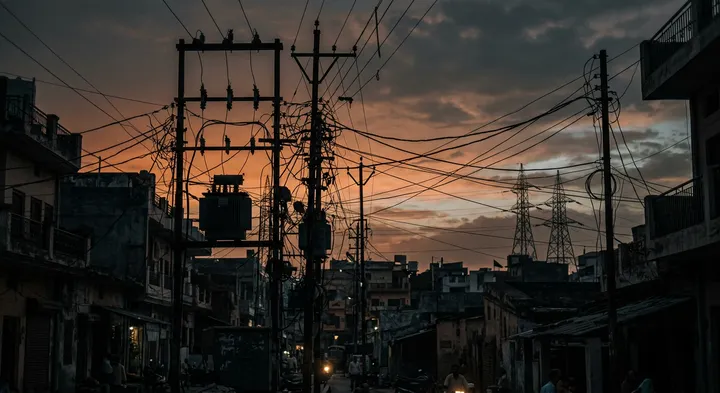
India's power distribution companies cleared most of their legacy dues in four years.
Photo · Illustration: Business Index
The discom time bomb was defused — but a new overhang has taken its place
The Rs 1.4 lakh crore in legacy dues that alarmed everyone in 2022 has collapsed to a fraction. The real risk in India's power distribution has quietly changed shape.
For years, the phrase "discom time bomb" came with a number attached: Rs 1.4 lakh crore, the mountain of unpaid dues that India's state power distribution companies owed generators. It was the standard shorthand for a sector on the brink. The problem with the shorthand today is that the number is wrong — spectacularly so — and the real risk has moved somewhere else.
The bomb that was defused
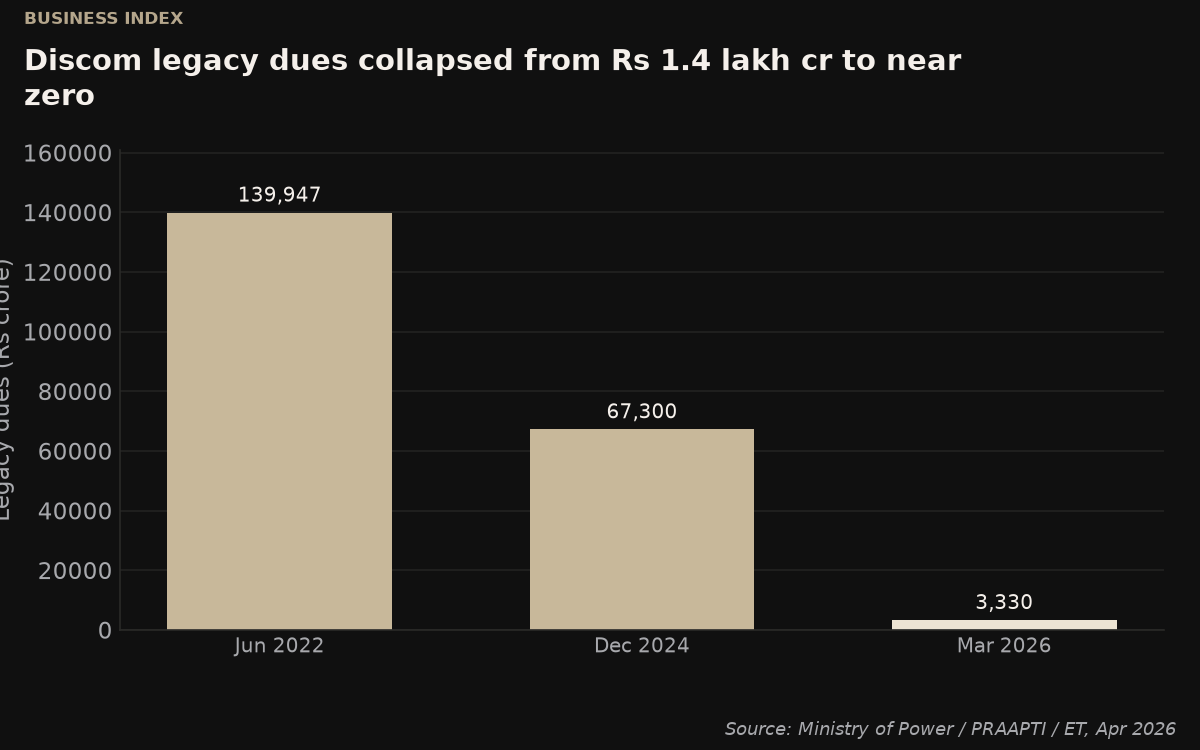
The Rs 1,39,947 crore figure was the peak of legacy dues, recorded on 3 June 2022, the day the Late Payment Surcharge rules were notified to force a cleanup (Source: Ministry of Power, 2026). Those rules worked. By 27 March 2026, legacy dues had fallen to just Rs 3,330 crore — a 97.6% reduction in under four years, achieved through a structured EMI framework (Source: Economic Times / Ministry of Power, April 2026). The "and counting" framing that usually accompanies the Rs 1.4 lakh crore number is not just outdated; it is directionally backwards. The dues fell, they did not rise.
The famous Rs 1.4 lakh crore was a 2022 peak. It has since collapsed by 97%. The old bomb is defused.
Where the risk actually sits now
That does not mean the sector is fixed. The live overhang is current dues, not legacy ones. On the PRAAPTI portal, current dues stood at about Rs 13,594 crore and total dues at Rs 16,894 crore as of March 2026 (Source: PRAAPTI / ET, April 2026). A snapshot from December 2024 showed discoms owing generators around Rs 67,300 crore before the subsequent improvement (Source: Mercom India, January 2025). The bills that keep coming due are the ongoing risk; the historical pile has largely been cleared.
The structural wound
The deeper issue is operational, not just financial. Aggregate technical and commercial (AT&C) losses — power that is generated but never billed or paid for — fell to about 15.4% in FY2023 from 22.3% in FY2021 (Source: Ministry of Power / PIB, 2023), a real improvement but still high, and far worse in the weakest states. The Revamped Distribution Sector Scheme has sanctioned about Rs 2.83 lakh crore of works, tying smart metering and loss reduction to performance conditions.
The honest map
There was even a rare bright spot: discoms posted an aggregate profit of about Rs 2,701 crore in FY2025, their first in years (Source: Economic Times, 2025). The accurate map of the discom problem in 2026 is therefore not a Rs 1.4 lakh crore time bomb ticking louder. It is a defused legacy, a manageable current-dues overhang, and a slow, incentive-driven grind to fix the structural leakage that created the problem in the first place. The crisis has not vanished. It has changed shape — and pretending otherwise misreads the map entirely.
Sources
One email. Saturday morning.
The week that mattered.
The five stories you needed to read, the data point of the week, and what to watch. From the Business Index editors. No ads, no fluff.