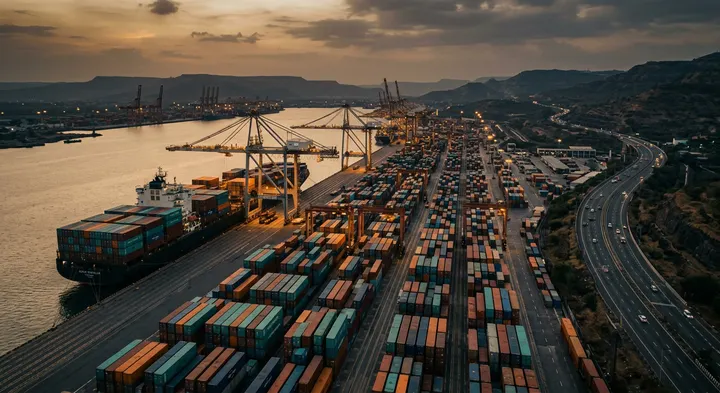
India's supply-chain rebuild spans ports, electronics factories and Grade-A warehouses.
Photo · Illustration: Business Index
The Rebuilders: the operators fixing India's broken supply chains
India's logistics cost has halved as a share of GDP in a decade. Behind that number is a scattered cast of operators rewiring the country's ports, factories and warehouses — and a job only half done.
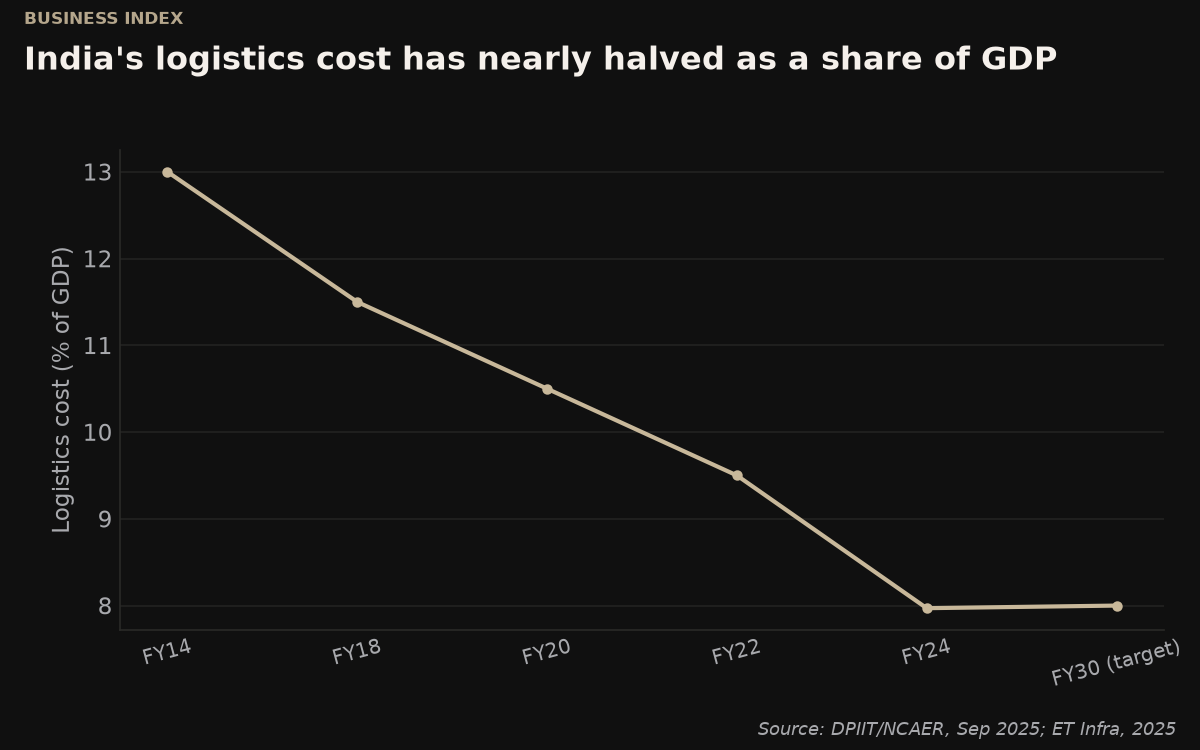
For decades, the single most quoted indictment of the Indian economy was a number: logistics cost, said to run at 13–14% of GDP against a rich-world benchmark closer to 8%. It was shorthand for everything that made Indian goods slow, expensive and uncompetitive — clogged ports, empty return-hauls, warehouses that were really just sheds. That number has now moved, and the story of how is the story of a scattered, unglamorous cast of operators rebuilding the country's physical plumbing.
The number that moved
The DPIIT/NCAER assessment released in 2025 put India's logistics cost at 7.97% of GDP for FY2024 (Source: DPIIT/NCAER via Hindu BusinessLine, September 2025) — down from the 13–14% that policy documents cited for years (Source: ET Infrastructure, July 2025). A word of honesty belongs here: part of that fall reflects better measurement, not only real improvement, since the NCAER study is the first rigorous baseline. But even discounted for methodology, the direction is unambiguous, and it did not happen by accident. It happened because specific pieces of infrastructure got fixed.
The 13% has become 8%. Some of that is better measurement. Most of it is concrete, steel and software that someone actually built.
The ports
Start at the coast. Jawaharlal Nehru Port secured 23rd place globally in the World Bank's 2024 Container Port Performance Index and ranked among the top improvers over 2020–2024 (Source: ET Infrastructure, September 2025). A port that moves boxes in hours rather than days changes the economics of every exporter behind it. This is the least visible and most consequential kind of rebuild: dwell times compressed, throughput lifted, without a single headline most consumers would notice.
The railways
Inland, the Dedicated Freight Corridors are the spine. By mid-2024 they were about 96% complete, freight-train operations were up roughly 60% year on year, and hundreds of goods trains a day were running on dedicated tracks freed from passenger congestion (Source: ET Infrastructure, July 2024). Moving freight off crowded mixed-use lines and onto purpose-built corridors is exactly the kind of structural fix that shows up, eventually, in a national cost ratio.
The factories
The most dramatic rebuild is in electronics. India became the world's third-largest mobile-phone exporter at about $20.5 billion (Source: Economic Times, 2025), and the PLI scheme for large-scale electronics has crossed cumulative production of Rs 6.61 lakh crore while creating around 1.85 lakh direct jobs (Source: PIB / MeitY, 2026). This is not just a manufacturing story; it is a supply-chain one, because assembling phones at scale forces component ecosystems, testing, and logistics to be built alongside. The operators here are promoter-led manufacturers — Dixon Technologies, whose FY25 revenue surged about 120% to roughly Rs 38,880 crore, and Kaynes Technology among them — as much as they are the marquee names.
The warehouses
Then there is the box the goods sit in. Grade-A warehousing stock across the top eight cities grew from about 88 million square feet in 2019 to around 238 million by 2024 — a 22% compound annual growth rate (Source: JLL India, January 2025). Modern warehousing, built by institutional developers like IndoSpace and ESR, replaces the leaky sheds of the past with racking, automation and highway access. Warehousing absorption grew about 25% year on year in the first half of 2024, with the sector projected toward 595 million square feet by 2027 (Source: JLL India, 2024).
The operators
Who actually did this? Not a tidy list of a dozen founders, whatever the pitch decks claim. It is a mixed cast: first-generation logistics entrepreneurs like Delhivery's Sahil Barua, BlackBuck's Rajesh Yabaji and Xpressbees' Amitava Saha, who digitised trucking and last-mile delivery; promoter-led manufacturers like Dixon's Sunil Vachani and Kaynes' Ramesh Kunhikannan; institutional developers like IndoSpace's Rajesh Jaggi; and corporate arms like Mahindra Logistics and Tata Electronics. They do not collapse into a single archetype, and that is precisely the shape of the transformation — distributed, sector-specific, and unromantic.
The work half done
The temptation is to declare victory at 7.97%. That would be a mistake. The figure sits roughly at the government's own FY2030 ambition already, which tells you either the target was modest or the measurement generous — probably both. The harder gains from here are in the last mile, in cold chain, in the weakest states and smallest towns where the rebuild has barely started. India has done the visible, capital-intensive part: the ports, the corridors, the Grade-A parks, the phone factories. What remains is the granular, stubborn work of extending that spine into the capillaries. The rebuilders have proven it can be done. They have not yet proven it can be finished.
Sources
- India's logistics cost at 7.97% of GDP in FY24 — Hindu BusinessLine / DPIIT
- PM Gati Shakti cuts logistics costs: NCAER — ET Infrastructure
- JN Port secures 23rd global spot in World Bank 2024 CPPI — ET Infrastructure
- India's logistics absorption hits 504M sq ft record in 2024 — JLL India
- India becomes world's 3rd-largest mobile exporter at $20.5bn — Economic Times
- Freight train ops up 60%; DFCs 96% complete — ET Infrastructure
One email. Saturday morning.
The week that mattered.
The five stories you needed to read, the data point of the week, and what to watch. From the Business Index editors. No ads, no fluff.