
India's central bank answers to a different mandate than the US Federal Reserve.
Photo · Illustration: Business Index
The RBI is not the Fed — and that's the point
Markets keep reading Mint Street through a Washington lens. But the RBI has one mandate to the Fed's two, targets a different metric, and in 2025 cut while the Fed held. The divergence is structural.
Every time the Federal Reserve moves, Indian commentators reach for the same reflex: what does this mean for the RBI? It is the wrong question, or at least a lazy one. The Reserve Bank of India is not a smaller, tropical Fed running a few months behind. It answers to a different mandate, targets a different number, and in 2025 did the opposite of what Washington did. The divergence is not a lag. It is the point.
One mandate, not two
The structural difference is legislative. Under the RBI Act as amended in 2016, the RBI has a single mandate: price stability, defined as 4% CPI inflation within a 2–6% band (Source: RBI monetary policy framework). The Fed carries a dual mandate under its 1977 statute — maximum employment and price stability, targeting 2% on the PCE measure (Source: Federal Reserve). The Fed must constantly trade jobs against inflation. The RBI, by law, does not. That single fact explains why the two banks can look at the same global shock and reach different decisions.
The Fed balances jobs against prices. The RBI, by statute, watches prices alone. Same shock, different reaction function.
The 2025 inversion
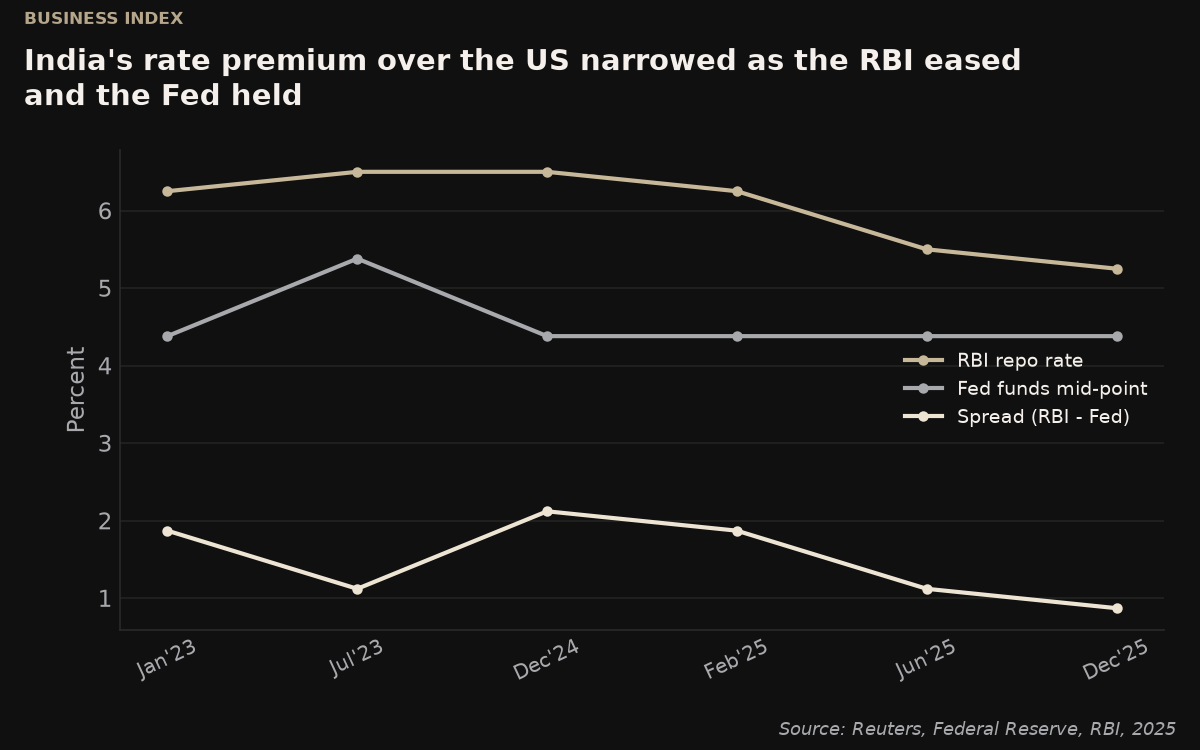
The recent record makes the divergence concrete. The RBI held its repo rate at 6.50% across 11 straight meetings from February 2023 while the Fed hiked to a peak of 5.25–5.50% and then cut 100 basis points through end-2024 (Source: Reuters; Federal Reserve). Then the roles inverted: in 2025 the RBI eased by 125 basis points to 5.25% as inflation fell, while the Fed paused at 4.25–4.50% on sticky prices (Source: Reuters, December 2025). At one point the two banks were moving in opposite directions entirely.
Why India could cut
The permission to ease came from the data, not from the Fed. India's CPI averaged about 4.6% in FY2024-25, its lowest since 2018-19, and printed as low as 2.82% in May 2025 — a multi-year low well under target (Source: PIB / NSO, 2025). That handed the RBI a real policy rate near +2.7%, an unusually high positive real rate that created room to cut without stoking inflation. The Fed, facing core inflation stuck above target, had no such room.
The contradiction worth holding
The India–US rate spread compressed from about +2.1 points in late 2024 to +0.87 by December 2025 (Source: Reuters; Federal Reserve) — but through completely different mechanisms: the RBI eased on falling inflation, the Fed held on sticky inflation. Read through a Washington lens, that convergence looks like India catching down to the Fed. Read correctly, it is two independent banks arriving near the same place for opposite reasons. The lesson for anyone trading Indian rates is to stop watching the FOMC for cues and start watching Indian CPI. The RBI is not the Fed. Pretending otherwise is how you misread both.
Sources
One email. Saturday morning.
The week that mattered.
The five stories you needed to read, the data point of the week, and what to watch. From the Business Index editors. No ads, no fluff.