
The new regime's effective rate rises steeply through the Rs 12-25 lakh band.
Photo · Illustration: Business Index
The real cost of the new tax regime, for households earning Rs 15-50 lakh
Zero tax at Rs 12.75 lakh, 22% at Rs 50 lakh — and a brutal surcharge cliff just past it. The new regime's effective rate climbs fastest exactly where the middle class lives.
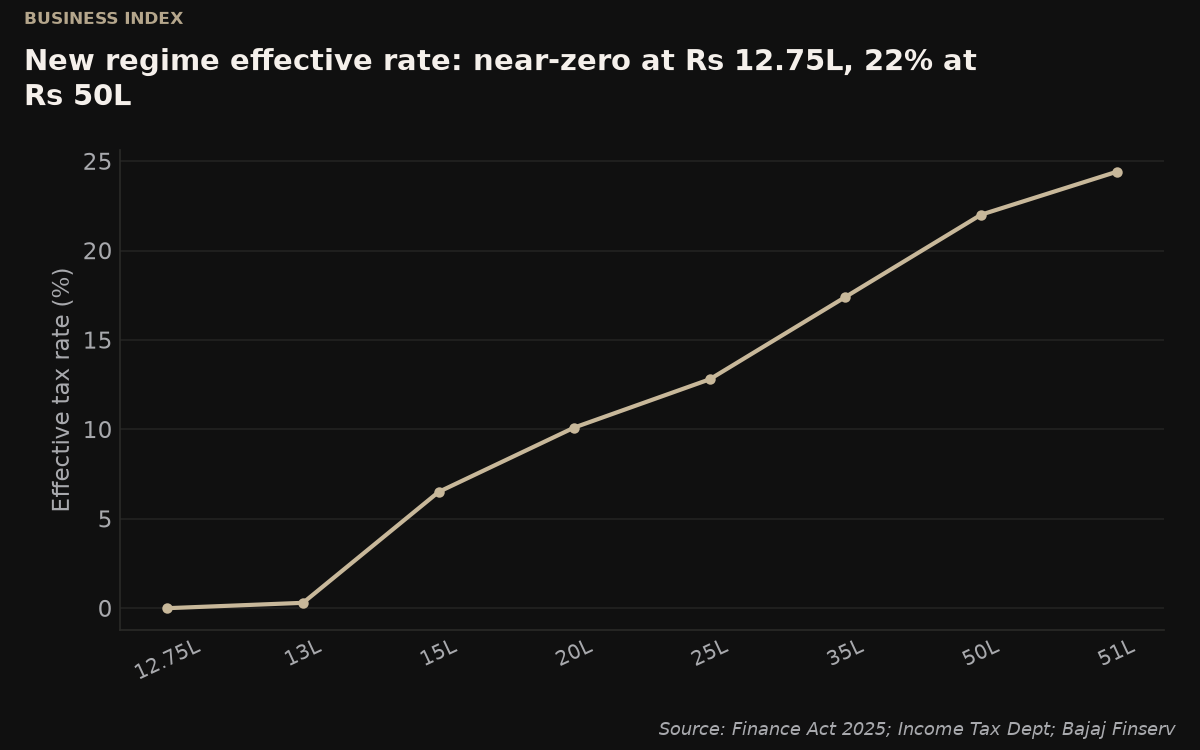
The new tax regime is usually sold on one number: zero tax up to Rs 12 lakh of income. That is true and generous. But it hides how quickly the burden ramps once you cross it — and a nasty cliff waiting just above Rs 50 lakh. This is the template for what the new regime actually costs a household as income rises.
The bottom: genuinely zero
Thanks to the Section 87A rebate and the Rs 75,000 standard deduction, a salaried person earning Rs 12.75 lakh gross pays nothing (Source: Finance Act 2025; Bajaj Finserv). But the rebate is a cliff of its own: at Rs 13 lakh gross the tax is about Rs 3,900 — a jump from zero that, while small, marks where the free ride ends.
The steep middle
The effective rate then climbs fastest through exactly the band where India's salaried middle class sits. At Rs 15 lakh, effective tax is about 6.5% (Rs 97,500). At Rs 20 lakh, about 10.1%. At Rs 25 lakh, about 12.8% (Source: Income Tax Department; ClearTax). The Rs 12–25 lakh stretch is where each additional rupee of income is taxed hardest at the margin — the aspirational middle pays the steepest slope.
The new regime is kindest at the bottom and steepest through the middle — the opposite of where most earners feel the squeeze.
The Rs 50 lakh surcharge cliff
At Rs 50 lakh gross the effective rate is about 22.0% (Rs 10.99 lakh) — and here sits a quirk worth knowing. Because the surcharge triggers on total income above Rs 50 lakh, a Rs 50 lakh gross salary lands at Rs 49.25 lakh after the standard deduction, just under the threshold, so no surcharge applies. But at Rs 51 lakh gross, total income crosses Rs 50 lakh, the 10% surcharge kicks in, and tax leaps to about Rs 12.44 lakh — an effective 24.4% (Source: Income Tax Department; PwC). A Rs 1 lakh raise can cost far more than Rs 1 lakh.
The template takeaway
The new regime does cap surcharge at 25% (against the old regime's 37%), which helps the very top. But the practical lesson for a Rs 15–50 lakh household is twofold: the marginal pain is worst through the Rs 12–25 lakh band, and the surcharge cliff around Rs 50 lakh of total income deserves active management — through timing, NPS contributions, or other levers — because stepping over it is uniquely expensive. Zero-tax-at-Rs-12-lakh is the marketing. This is the cost.
Sources
One email. Saturday morning.
The week that mattered.
The five stories you needed to read, the data point of the week, and what to watch. From the Business Index editors. No ads, no fluff.