Three BoJ hikes in eighteen months redrew the cost of the world's cheapest funding.
Photo · Illustration: Business Index
What the BoJ pivot means for India: the carry-trade unwind, in three charts
The Bank of Japan has taken three steps out of zero. Each one tests how much of the global carry trade is quietly funded in yen — and India feels every tremor.
The Bank of Japan spent a generation as the world's zero-rate anchor — the place you borrowed for almost nothing to fund a bet somewhere else. In eighteen months it took three steps away from that role, and each step matters to India more than the size of the move suggests.
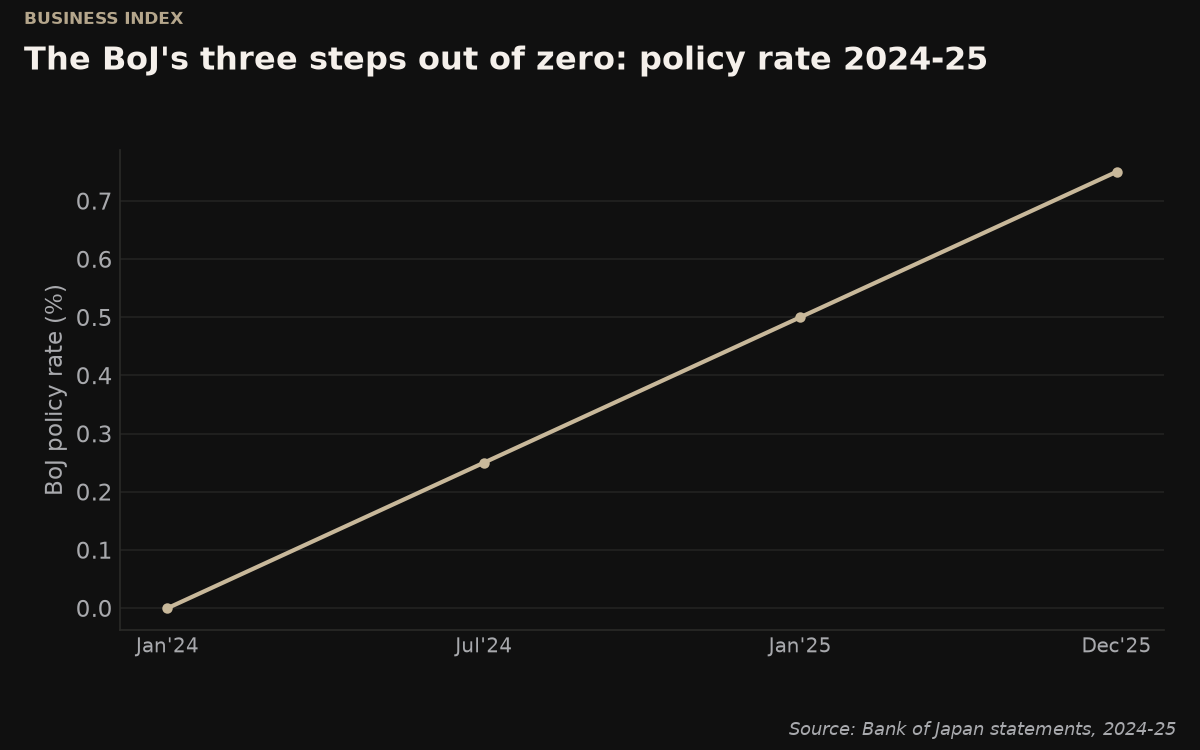
Chart one: the exit from zero
The path is short and consequential: 0.00% at the start of 2024, up to 0.25% in July 2024, 0.50% in early 2025, and 0.75% by 19 December 2025 — the highest Japanese policy rate since September 1995 (Source: BoJ statements, 2024-25). Three hikes totalling 75 basis points would be trivial in most economies. In Japan, they represent the dismantling of the cheapest funding source in global finance.
A 75-basis-point move in Tokyo does more to global risk appetite than a 75-basis-point move almost anywhere else.
Chart two: when the yen moved, India felt it
The August 2024 episode is the template. As the yen appreciated sharply — from around 160 to 142 per dollar — leveraged carry positions were forced to unwind, and the tremor reached India as a ₹21,201 crore FPI outflow in two weeks (Source: Economic Times, August 2024; BIS Bulletin 90, August 2024). The carry trade is, in the BIS's own words, "notoriously difficult to size," with cross-border yen borrowing and FX derivatives together running into the trillions of dollars (Source: BIS Quarterly Review, September 2024). Nobody knows exactly how big it is, which is precisely why each BoJ hike is watched so nervously.
Chart three: India fared better than its peers
The reassuring part is relative resilience. In the August 2024 unwind, the Nikkei fell around 20% while the Nifty 50's drawdown was a fraction of that (Source: HDFC Fund, August 2024). India's direct yen exposure is small, its FPI base is mostly dollar-funded, and domestic institutional flows have become a powerful shock absorber.
The signal for India, then, is not panic — it is vigilance. Every incremental BoJ hike raises the cost of the global carry trade and increases the odds of another forced-selling episode. India will not be the epicentre of that quake. But as August 2024 showed, it will feel the ground move, and the three charts above are the dashboard worth keeping open whenever Tokyo meets.
Sources
One email. Saturday morning.
The week that mattered.
The five stories you needed to read, the data point of the week, and what to watch. From the Business Index editors. No ads, no fluff.